Monday, September 21, 2020

Selected Meaningful Quotes, Must Reads, Must Sees & Practical Rules for Living


July 2012: For Baelyn...before I forget.   
[Updated September 2020:  And of course...for Bardeaux too!]

Lately the 80s movie classic Teen Wolf (one day you will recognize its genius) has been airing on cable, and I keep stumbling on the scene where slacker basketball coach Bobby Finstock pulls his star player Scott Howard aside for a word or two of advice.  Finstock tells him, 

"There are three rules that I live by: 
never get less than twelve hours sleep; 
never play cards with a guy who has the same first name as a city; 
and never get involved with a woman with a tattoo of a dagger on her body. 
Now you stick to that, and everything else is cream cheese."


I think it's incredibly cool to have this kind of a list on demand and at your fingertips, and the ecclectic nature of his rules is just...well...awesome.  

So, Baelyn [updated: & Bardeaux] - probably since I just turned 40 [updated: almost 49!] and feel reflective, definitely because I want to be a good Dad, and absolutely because I want to be as cool as Bobby Finstock - I decided to make you a list of my own.  

Of course, my wisdom at this point is not nearly as developed as Finstock's, so I reserve the right to update my list until such time as it feels appropriately wise, or sage, or simply complete (perhaps when I can narrow it to only three?)  

Also, my rules are clearly not as colorful as his...but then again, unless you move to Vegas at some stage in your life, mine will probably have more practical value.  

Regardless, this was a valuable exercise for me, and I hope one day you can appreciate it too.

In random order...

Selected Meaningful Quotes, Must Reads, Must Sees, and Practical Rules for Living.  

Pursue a well-rounded education.  In my view, there is no better way, at least in terms of human connection and purpose and meaning.  (Although I grant you that for specific tasks like - for example - building the Golden Gate Bridge, an education more narrowly focused on engineering is probably more appropriate.) But for me, an important measure of success in the human/social connection sense may be the ability to speak to any person, anywhere, and find some common ground:  food, travel, literature, art, history, science, music...  

Resist the temptation to "sell out" (career-wise) for as long as you possibly can.  But chances are, you won’t be able to resist forever.  That's ok:  money, after all, buys time.  (And nothing is more valuable than the time to do what you want.)  But while you are able, there is also something to be said for the theory of "pursue what you love, and the money will follow."  There is no guarantee, but it just might.  

Stand up for yourself:  Don’t take crap from anyone, and it’s ok to recognize that sometimes bad people have it coming to them if they push too far.  But also be as kind and as generous as you can; and especially to taxi drivers, janitors, waiters/waitresses, and the like.  Don't assume that you were born to be served by others.  Appreciate their efforts and their honest day's work. 

When given a choice between watching a game and playing a game, always play.   
 
Participate in sport of any kind.  (Unless, of course, it involves killing something.  Please skip those.)  The friendship, loyalty, rivalry and camaraderie earned; the discipline, sacrifice and effort learned; the challenges and pressures overcome; and the intensity and passion enjoyed are all incredibly valuable by-products of the sports experience.  Also consider that for me, sport has been the great connector in my life.  The lessons of the locker room extend beyond race, religion, and creed...and the construct of team and family come to the fore.  I have often said that anyone who has shed blood, sweat, or tears alongside me on a court or in a locker room is my brother....and always will be.  Sacred bonds.  [Updated:  and now more than ever in the current 2020 landscape of George Floyd, Jacob Blake and others...when protests against racism and police brutality are occurring across our nation.  Sport has the power to transcend, and against today's "de-humanizing" backdrop of racial injustice, I believe that my past, present, and future teammates should know how much I value them as friends, people, and...human beings!]

Lets also spent some time on my favorite sport, basketball.  It is not lost on me that there is much, much more to life than basketball.  Yet I have also experienced it as something much larger and much broader than "just a game:"  for me, it has been a vehicle through which to cross (or at least navigate) barriers of religion, ethnicity, class, or culture.  When I played in Ireland, I was part of a program that levered the "neutral" sport of basketball to bring Catholics and Protestants together.  Throughout my career, locker rooms consisted of mixed races and mixed socio-economic statuses at rates probably higher than most classrooms or organizations.  And while travelling around the world post-9/11, I was warmly treated as a "local" rather than a tourist using pick-up basketball as an ice-breaker in countries like Seychelles, Kenya, Uganda, Tanzania, Australia, New Zealand, Palau, Burma, Thailand, and Laos.  Basketball has taught me lessons which I carry with me to this day as an employee, a father, a husband, a coach, and a human being.  It helped me establish friendships throughout my life that I might not otherwise have made.  It helped me connect -- to myself, to those near, to those similar, to those different, to those across distant oceans or continents that I never would have met were it not for a ball and a hoop.   So yes, to paraphrase Phil Jackson, "there is more to life than just basketball...but there's also more to basketball than just basketball."  

Study Sun Tzu and understand that the battle is won or lost before it is ever foughtThere is no substitution for preparation.  Also consider Muhammad Ali’s colorful spin on it:  The fight is won or lost far away from witnesses - behind the lines, in the gym, and out there on the road, long before I dance under those lights.   Extending further into Sun Tzu's argument, I would also offer that winning is great, but it’s nothing compared to the absolute calm – yet strangely euphoric – feeling of knowing you will win before it happens; of saying to yourself “I got this” or “this is my moment” or “this race/game/match/point is already won.”  Of course, to ever feel that way – especially under the intense pressure of the moment and before the victory is actually secured – you will have to have done hours and hours of work to “earn” that confidence and certainty.  But it’s worth it.  There is no better feeling than “I have already won this, this is my time…and no one here but me knows it yet.”  Yes, in my opinion, that feeling is better than actually winning.  And it’s certainly more rare. 

Embrace the concept of evolution, both in the massive biological sense but also in the small-scale genetic sense:  actively take the best traits of family and friends and push them forward in your own character.  Ignore the worst traits, and push them the way of the Dodo bird, dial-up internet service, Zubaz, and the Betamax

When you think about “little white lies” or if you find yourself in a moral dilemma at some stage in your life, consider the words of Oscar Wilde:  a true friend stabs you in the front.  

Be wary of the “grass is always greener” trap.  It’s tempting.  But instead, develop the understanding that happiness is not about getting what you want…it’s about still wanting what you already have. 

Stay away from debt.  Prior generations earned first, and then spent.  Respect that.   

Similarly, resist things that come too easily.  It’s often a trap.  Eventually you will take pride and perhaps even pleasure in overcoming the struggles and challenges you face.  The pay off for working hard at something is considerable.  Enjoying something you’ve actually earned for yourself is far, far different from enjoying something that comes easily.  

If I gave you the choice to lead, follow, or get out of the way, which would you choose?  My hope would be for you to lead...and if you were to do so, lead first by example.   

As a corollary, don't trust people who say "do as I say, not as I do."  Actions, not words, are the true measure of character.  As such, those who do have the courage to follow their own convictions are often worth your respect and your time.  

Words should count for something, however, so choose them wisely.  Also, don't be passive aggressive:  have the courage to plainly speak your mind.

When faced with a challenge, borrow from an unofficial saying of the United States Marines:  Improvise, Adapt, and Overcome.

When examining an issue, or a popular stance on a topic, try as much as possible to apply common sense in addition to objective, historical fact.  This is more important than ever in today's "cancel culture" paradigm, when anything tainted with a tinge of inappropriateness (of course, which is only viewed in today's lens by the "cancellers") is called out and subsequently destroyed.  Sure, this applies to statues of Confederate Generals, who fought - in part - to maintain the institution of slavery...but do we also stop listening to Michael Jackson because of (alleged) sexual misdeeds?  I am not seeking at all to discount the evils - and accountability to - supporting slavery, but do we also discard everything positive that Washington, Jefferson, or Hamilton achieved for this country, as products of their era because they were also "slaveowner, slaveowner, adulterer?"  Does Churchill get stricken from the record because he was most likely an alcoholic?  I believe all great men are deeply flawed in other areas of their lives - call this the "Michael Jordan Effect" - and are also generally products of their time.  Moreover, our nation itself is deeply flawed and is built on the back of cultural exploitation of both Native- and African-Americans.  We're imperfect...so let's do better.  But also...let's not too rapidly ignore, deny, or "cancel" anything that doesn't fit our modern construct.  After all...if we know one thing for sure, it's that our "modern" view will change again, and probably look pretty silly in a few hundred years. 

Right on cue, consider this throw-away line from the movie Men in Black and see it for something profound and insightful:  Fifteen hundred years ago everybody knew the Earth was the center of the universe. Five hundred years ago, everybody knew the Earth was flat…Imagine what you'll know tomorrow.  Remember, perspective is everything.  And it's also important - in fact, required - to constantly question the "concrete assumptions" everywhere around you.

In fact, John F. Kennedy made note of a similar concept in a speech at Amherst College - his last public appearance before his assassination, actually - in October 1963:  "The men who create power make an indispensable contribution to the Nation’s greatness, but the men who question power make a contribution just as indispensable, especially when that questioning is disinterested, for they determine whether we use power or power uses us."

And here’s another solid tidbit from Men in Black (who knew?):  A person is smart. People are dumb, panicky animals.  (Now go back and re-read Cat’s Cradle and consider that religion may be the greatest hoax ever propagated on the human race.) 

Realize that being a contrarian is harder said than done, and it’s often falsely – and hypocritically – romanticized.   Not to say one shouldn’t aspire to contrarianism…but it’s just that far too many people claim – with the obvious benefit of hindsight – that they would have been honorably struggling on the front lines of progress and change than is actually plausible.  For example:  It’s more than likely that if you were alive at the time, you would have been a slave-owner too.  Or at least sympathetic to the concept.  The same holds true for women’s rights, Native American rights, and a myriad other examples.  Have the integrity to admit that, and thus to more deeply appreciate true anti-consensus thought or action as it happened.  Although it is often worth it to “go against the grain,” it is also incredibly difficult and rare in practice.  Said another way, be as self-aware as possible, and don't succumb to the disingenuous temptation to pretend to be someone you are not, or someone you would never have been.   

As a natural follow-up to the previous thought...Resist the temptation to do what everyone else is doing.  Taking a moment to stop and think is always worth it. 

Waste some amount of time making sure people like you, but not too much.  At some point, it becomes a bit unctuous.  And, also at some point, maturity means accepting the fact that you can't be all things to all people.  It's ok if not everyone loves you.  

Similarly, check out the cheesy movie The Last Dragon.  (Or at least the first 60 seconds below.)  Don't always seek positive reinforcement from externalities.  Or at least don't depend on it to the exclusion of all other input.  And sometimes,  especially if you have "done the work," recognize that you may already be "the Master."  (Also read my blog about Canisius High School basketball and Coach Dave Butler for a more relevant example of this.) 


Speaking of mastery, read Musashi, the epic biography of one of Japan's most famous swordsmen.  It has it all...struggle, hardship, success, failure, love, passion, discipline, agony, honor, and loyalty.   Musashi said many great things, but here's something that stands out:  This is the Way for men who want to learn my strategy... Do not think dishonestly. The Way is in training. Become acquainted with every art. Know the Ways of all professions. Distinguish between gain and loss in worldly matters. Develop intuitive judgment and understanding for everything. Perceive those things which cannot be seen. Pay attention even to trifles. Do nothing which is of no use.  Another of my favorites relates to training and preparation, which is obviously a theme here:  Learn the principles, master the principles, forget the principles.  It's a great feeling to have learned something so well - whether algebra, a vocational skill, a sport, etc. - that it becomes easy and mindless.  Once you hit that point (also see Malcom Gladwell's book Outliers), success generally follows. 

But when you are good at something, resist the temptation to show off or boast.  As Bruce Lee noted in Enter the Dragon (see first 25 seconds below):  “Boards don't hit back.” 


Know when to call it a night:  recognize that nothing good happens after 1:00am... unless you are with family, sitting in your own backyard, in your dorm room, or just finishing up dinner in Italy, Spain, or France (and within walking distance of your bed).  And as a tangent, terrible things happen on roads after 1:00am...so be careful, please.

Similarly, get at least 8 hours sleep as often as possible…but don't waste too many mornings by sleeping in. 

Of course, also don't forget that the early bird does sometimes get the worm, but it's the second mouse that gets the cheese. 

Whenever you are on the fence of whether or not to roll out of bed for that morning workout, always go for it.  You will never regret the post-workout satisfaction and endorphin high.  Go!


Watch The Wire.  Like, immediately.  You will dig Seasons 1 and 2 but make sure you stick with it through some dry patches...because they are merely a set-up and a preface to the greatness that is Season 3.  It’s only the best television show ever created and a seminal work on the slow crumbling of the American Empire from the inside (urban centers) out.   And Season 3 is the pinnacle of the accomplishment.  Face it, we almost named you Bodie.  

Watch the entire Band of Brothers epic.  Recognize the bravery and sacrifice of those honorable men who fought to purge the world of evil, back when the difference between good and bad were fairly obvious.  (Of course, since my "family rule" is that we enjoy a Band of Brothers marathon on Thanksgiving - in order to truly "give thanks" and understand - then you'll probably have this covered already.)  

Yet also read David Hackworth’s About Face and understand the dangers of misguided, political wars.  Be true to yourself, despite the consequences…never be a “yes man.”  At the same time, recognize the honor in loyalty while perhaps at the same time not understanding it:  Hackworth took one painful path regarding Vietnam, while John McCain took another equally painful – while perhaps completely opposite – track.  But both men were heroes. 

In fact, if you are curious, I would probably list my favorite TV shows* in this order: 

1) The Wire
2) Band of Brothers (mini-series)
3) Breaking Bad
4) The Bear
5) House of Cards
6) Game of Thrones
7) Tie: The Deuce & Daisy Jones and the Six 

 *interesting that my favorites correlate with an interesting construct:  the TV show that knows it's full story, it's beginning and end, before it's even filmed.  For example, David Simon always said The Wire was a "book with 60 chapters...12 shows x 5 seasons."  That limited arc tends to create a tight storyline and avoids the obvious pitfalls (Fonzie jumping the shark) of TV shows that get more and more ridiculous just to maintain viewership, banking on the dramatic and the absurd rather than a tight storyline.  

Of course, I could make an entirely separate list for the 80's and the excitement of TV as a kid, even with only 4 channels!  But I'd have to highlight The Greatest American Hero, Buck Rogers, The Six Million Dollar Man, Dukes of Hazzard, Magnum PI, and Saturday morning WWF as my favorites then.  Along with Three Stooges reruns and vintage Bugs Bunny...  

Read Cat’s Cradle.  Recognize the absolute genius of Kurt Vonnegut.  Be wary of organized religion; yes, it may have had a place once in "civilizing" barbarians and giving our forebears a "higher purpose" than constantly raping and pillaging their neighbors, but that time has past and the entire construct currently borders - in my opinion - on the ridiculous.  And, unfortunately, the destructive.  Vonnegut makes his case more elegantly than anyone ever has.  Across the body of his work, his ability to satire the foibles of humanity make him required reading for anyone truly seeking to be "self-aware."  

Study Colonel Glover S. John’s Basic Philosophy of Soldiering There are valuable leadership tips within, including several of my favorites:  Strive to do small things well…Never be satisfied; ask of any project, how can it be done better?...The harder the training, the more the troops will brag…Yelling detracts from your dignity; take men aside to counsel them…and Stay ahead of your boss. 

Understand that “champions are made when no one else is watching.”  There is a right way to do things; and do them right simply because you want to extend the concept of “right” into the universe.  If the Buddhists maintain that you can find spirituality and divinity in the concept of repetitive menial tasks (“chop wood, carry water”) then you can make the effort to use your turn signal even though no one is around…you can touch the lines when you run sprints…you can wash the extra spoon, lift the chair when you vacuum, properly footnote the research paper, etc.  Do things right.  Be that person; just because you can.  And while I have my issues with the Jesuits over their dogmatic religious teachings, there is value in the concept of magis.  (Loosely translated as "do more”…just drop the "for Christ" part.) 

Check out  John Wooden's Wooden: A Lifetime of Observations and Reflections On and Off the Court The former UCLA coach and legend positively impacted millions of lives - both directly and indirectly - as a teacher of the game of basketball...and life.  One of my favorite quotes from Wooden (and he has many) is "never mistake activity for achievement."  Even though he used this while coaching UCLA to multiple NCAA titles in the 60s, it holds up incredibly well, especially in today's frenetic, quantity-over-quality, shallow, information-overload world.   Just as blindly running around a basketball court at a rapid pace (activity) hardly qualifies as achievement (execution, scoring...or winning), hyperactive media coverage or rehashed Hollywood movies (which seem to get dumber and dumber) or frantic on-line blog posts or reviews create the illusion of activity, but hardly count as achievement.  This reminds me of the physics concept of velocity, which - in my mind - is much more powerful that pure speed, simply because velocity is speed in a particular direction, implying it is directed and focused toward a particular goal.  Incidentally, Wooden was also a major proponent of the "yelling detracts from your dignity: take men aside to counsel them" sentiment of Colonel Johns above.  He never berated players in front of others, but instead took them aside to explain what they might have done wrong and what they needed to do to correct the mistake and thus improve.   

Read David Foster Wallace’s This is Water Recognize his brilliance and his honesty.  See and understand the "water" all around you, and learn how to navigate it.  In particular, try to see yourself as something other than the center of the universe.  Make the effort to include someone else's perspective in your world view.  Said another way, seek first to understand, before you would be understood

Laugh your way through the movie The Princess Bride, but also take away valuable lessons:  the strength of true love, the code of honor, the power of loyalty, preparation, and well-roundedness.  And remember Wesley’s line:  We are men of action, lies do not become us.  

In fact, do not lie, cheat, or steal.  Be better than that.  But do it because you can, not because someone tells you that you have to.   

See Cinema Paradiso and commiserate with the sadness of leaving the known and the comfortable for the unknown and the difficult.  The pain is enduring, yes, but the payoff is huge.  

Similarly, pay homage to the Mark Twain quote Travel is fatal to prejudice, bigotry, and narrow-mindedness, and many of our people need it sorely on these accounts. Broad, wholesome, charitable views of men and things cannot be acquired by vegetating in one little corner of the earth all one's lifetime I will be sad to see you go one day, but I will also rejoice in your pursuit of life’s opportunities.  Life is in the living.  Be a doer, not a watcher.  Go and be…don’t stay and wish. 

As a corollary to the above, remember that the only thing permanent in life is change.  Keep yourself off balance, revel in the adjustments, and recognize that it makes you wiser, stronger, and better.  

Sidenote:  Favorite movies?  Hmmm... this will be a work in progress.  I can best define these as "if I were to stumble across these movies while changing channels, I will absolutely stop and watch" plus a meaningful story/message.  Off the top of my head:

Feel Good:  The Princess Bride...The Last Dragon...Good Will Hunting
Riveting:  A Few Good Men...Jean de Florette...The Count of Monte Cristo...Shawshank Redemption...Lock, Stock, & Two Smoking Barrels
Sport:  Hoosiers...The Natural...Rocky III + Rocky IV
Adventure:  Raiders of the Lost Ark...Star Wars + Empire Strikes Back + Return of the Jedi...Gladiator...Braveheart
Meaning/Message:  Captain Fantastic...Cinema Paradiso...Wall-E
Pure Fun:  Love Actually...Notting Hill...Wizard of Oz...West Side Story...Singin' in the Rain
Adolescent Impact:  The Breakfast Club...Sixteen Candles...Karate Kid...The Last Starfighter...Back to the Future 

Another great quote, this time courtesy of Albert Einstein:  insanity is defined as doing the same thing over and over again yet expecting a different result.  

Seek to constantly change and improve the world around you, starting with the things at your fingertips and moving outwards.  The most dangerous combination of words in the English language might be ...because that's the way it's always been done.

Finally...no matter what your path in life:  be firm, be strong, be proud, and don't be distracted by others, by nonsense, or by short-term thinking.  Consider the Ancient Greek philosophy of Euthymia, loosely defined by Seneca as "peace of mind." An alternative interpretation is “believing in yourself and trusting that you are on the right path, and not being in doubt by following the myriad footpaths of those wandering in every direction."  (It's worth reading up on the Stoics, too.)  But in other words, trust that your path is true...and is the best path for you to be on.  Don't suffer fools or distraction.  Besides, it's also important to remember that "there's only one thing in life...and this is it." 


Tuesday, June 4, 2019

The 1996-1997 Season: Three countries, three teams, and 22,544 miles flown...


This one's for my girls...and may prove relevant as we plan to visit Malta in October 2019!

To properly tell this story, I need to begin with a step back to 1995-96 for some important background.


INTRODUCTION

As the first in-depth story I have taken on regarding my European basketball experience, I should disclose an important fact from the outset:  My overseas experience should in no way be confused with that of current- and ex-NBA'ers who enjoy salaries in the millions playing in Greece, Spain, France, Israel, et. al.  Mine was probably something closer to Triple-A baseball (actually...Double-A) in this country.  Or the professional lacrosse league.  In other words:  I played in the mid- to low-level European leagues, and not the top-flight leagues producing many of today's foreign NBA players.

So the leagues stunk, yes.  But it was also probably about the best I could do.  I set out not to become famous, nor to make lots of money...but to hopefully succeed in the attempt to push my own boundaries and to maximize my own potential.  To live life.  In my view, this is the promise of Sport:  To achieve the absolute maximum result that one can, given one's opportunity-set and one's talent.

Despite the lack of big-name talent, bright lights or big arenas during my basketball experience, I should also note that I am proud to have even received a paycheck at all.  I feel strongly that receiving pay - however small - does correlate my mid-level experience in some way to the "big league" basketball experience.  After all, the mindset is the same, even if the arenas and practice facilities are smaller:  a paycheck is a paycheck.  Also, consider that at any given time, there are roughly 5,000 American players receiving pay for basketball somewhere in the world.  I'd argue that being in the top 5,000 people in the world at doing anything is fairly impressive and I take my once-professional status (as meager as it may have been) as a point of pride.  Moreover, as not much more more than a 6-foot, not-especially-fast-nor-athletic guy, you might recognize the themes of mental toughness and resiliency (along with lots of good luck!) as paramount throughout this story. 

"Success is peace of mind, which is a direct result of self-satisfaction in knowing you did your best to become the best that you are capable of becoming."  --Coach John Wooden


DISCLAIMER

As I write, I plan to shift between fictitious names and actual names, depending on the circumstance.  For example, I may protect certain people by tagging them with a pseudo-fictitious name.  Others, depending on my experience with them, may not deserve such protection.  And those people who deserve all the praise and accolades in the world (in my opinion) will be named truthfully in recognition of that fact.  To simplify - if they were a saint or a sinner, I will probably use their real name.  And if they were somewhere in between, or relatively inconsequential to the story and don't need the unwarranted Google-hit, I will use a made-up name...unless they are guys I played against and there's no need to obfuscate.  Confused?  I am too...but let's just see how it goes...


PROLOGUE
Ireland 1995-96, The Short Version.  

In September 1995, I found myself on a $350 flight from Toronto to Dublin, Ireland to join the Dungannon Basketball Club in Northern Ireland.  Dungannon's GM, Frankie O'Loane, had gotten a hold of my VHS highlight tape and my player resume, and had looked beyond my stature and small-school background to note that I had had a brief professional experience in Costa Rica.  As a result, he extended an invitation for me to join the team, but noted the tight budget constraints and added that the travel expense had to be on my own dime.  I was a bit disappointed in that, and this was perhaps the first small moment when my romanticized version of "professional basketball" would be deflated.  Yet given my limited prospects at that time, I felt that $350 was a small price to pay for a jaunt across the pond, and I went for it.  I bought a round-trip ticket with the longest possible return flight, which was roughly six weeks (mid-October) from my September 5th departure date.  Obviously, I hoped the return could be changed, or - better yet - altogether scrapped as unnecessary after Frankie had also noted the names and numbers of his two recent American imports, and they were both upstate NY guys with whom I had good conversations.  One was their current American, a guy from central New York who had played at Colgate University.  Let's call him Jonathan Rock for the sake of anonymity.  As I considered my options and prepared for the trip over, I felt great about Dungannon.  I believed that I fit the player/personality profile Frankie was after and would easily mesh with an American teammate from New York.  In short, I felt I would be in very good hands.

The weeks leading up to my departure, were a blur of workouts, goodbyes, and butterflies.  On the workout front, I was killing it...but still not too far off a severe ankle injury my senior year of college which - in my opinion - may have prevented my team (Amherst College) from hoisting the 1994 DIII National Basketball Championship.  Yes, I truly believe that.  First, it was one of the best, most-balanced teams I had ever been a part of.  Second, the team was hitting a whole new gear as the post-season approached, which was the first in which academic-oriented NESCAC schools would be allowed to participate.  And third, I achieved a personal second-wind towards the end of that season that I just knew would propel us to the title in storybook fashion.  (Storybook in part because the Final Four that season was to be held in Buffalo, NY...about a mile from my high school!)  It all came crashing down with a shredded right ankle, and I was destroyed.  We ended up losing in the Elite Eight to the eventual national champs Lebanon Valley, who were led by stellar point guard (and former summer camp teammate) Mike Rhoades and one-hell-of-a-coach Pat Flannery (who went on to fame as Bucknell's NCAA-Cinderella-giant-killing leader).  We lost by 9, and I scored 8 points while wearing an air cast over my torn ankle ligaments...and I actually chipped the ankle bone trying to force myself to play.  The reason all this is relevant is how it solidified my love of "injury rehabilitation."  I embraced rehab like a man possessed, and for the first time in my basketball career began to understand the value of sprint-work and physical therapy.  I realized that I could use the time to get better and I ran sprint after sprint after sprint.  My injury had left me with something to prove - and unfinished business - as a player.  (I should send a shout out to Amherst coach Dave Hixon here, for introducing me to the grueling "20 suicides in 20 minutes" workout.  Basically you'd run a suicide plus one length in any time under a minute - full speed is about 32 seconds and a jog is 45-50 seconds - and you use the time until the next minute as rest before starting again as that next minute starts.  I latched onto this as a daily exercise because I could not round corners because of my ankle, and the straight-up-and-back nature of the suicide was perfect for me.  I did these every which way possible...5 of them with a 35 second limit with 25 seconds rest, then 5 at 40 seconds with 20 seconds rest, back to 5 at 35 with 25 seconds rest, and then a final blast of 5 at 32 seconds or better...or sometimes a slow jog of all 20 in 50 seconds with 10 seconds rest.  Either way, it got me into crazy good shape.  And with the stop-start sprint to w

[Sidebar:  While I truly believe that were it not for that ankle injury, we'd have won the National Championship, I also realize that I may never have tapped in to the inner desire, anger, and hunger necessary to drive me to become a true professional.  Looking back, it's such an interesting hypothetical:  Would I rather have won that title, and never gone to Europe?  Or played in Europe as I did and forgone the title?  Let's just say that I am a little nostalgic at times, but Amherst's basketball program has exploded since than and garnered not only a national title (2008) but much-deserved accolades as a national power, and I am quite happy with exactly how things turned out for me in the end.]

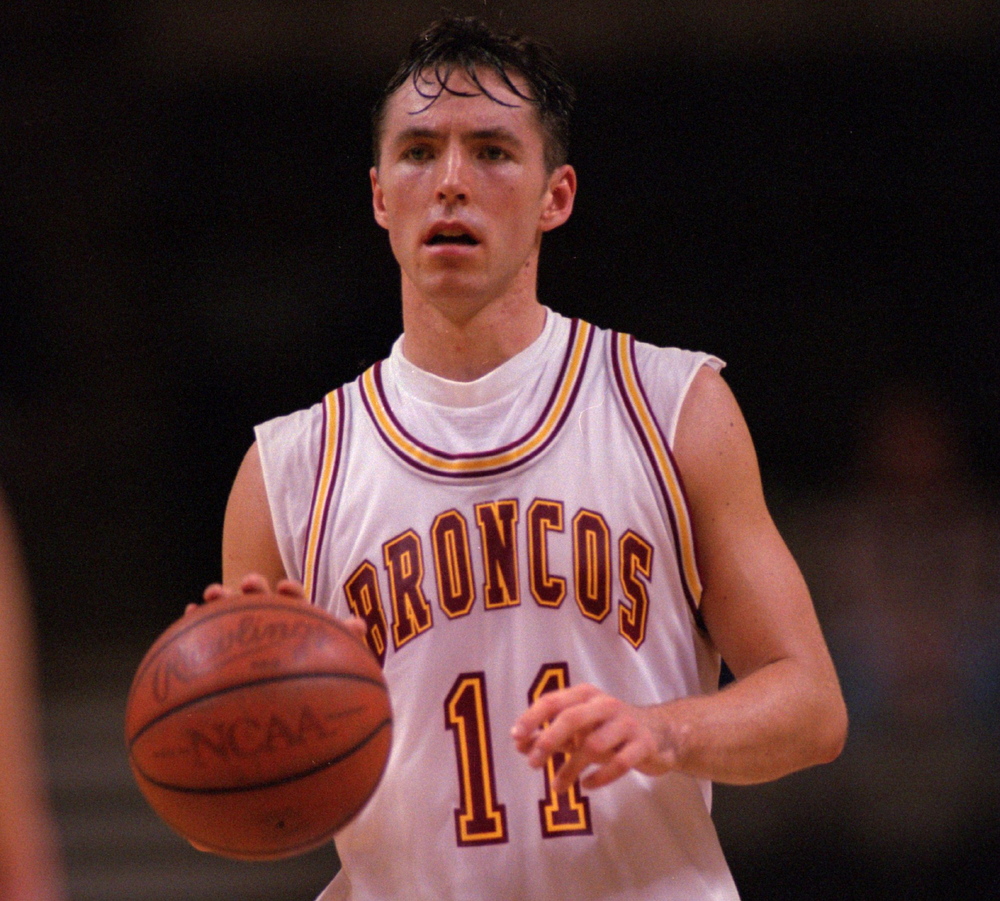
So, in short, the heart-breaking ankle injury I suffered in 1994 served to teach me another series of immensely valuable, sports-related lessons:  work hard to improve yourself, deal with - and maybe even embrace - pain and frustration as a means to get better both mentally and physically, rise to the challenge, and remember that every door that swings closed might also - it's really just a matter of perspective - be swinging open to a new opportunity.  And by the time the opportunity to play in Ireland came around (after a brief experience in the *top notch* Costa Rica League), I was leaner, trimmer, faster, and more explosive than I had ever been.  It was a subtle change, but a critical one that is best illustrated by young Steve Nash and trimmed-down MVP Steve Nash.

What followed during the end of that 1995 Summer, however, was just another reminder of that "Murphy's Law, roll-with-the-punches, keep grinding, if-it-doesn't-kill-you-it-just-makes-you-stronger" aspect of sports noted above:  playing in a summer league game with the Colt 45 All-Stars (yeah, you read that right, see pic below from an earlier summer on that team), I stepped on my defenders foot while driving to the basket and subsequently rolled my left ankle.  WTF!  This was late August...Ireland was days away, and I now had an ankle the size of a grapefruit.

Colt 45 All-Stars, ~1990 Summer League
Front:  Bernard, Cubby w/ Summer League Champs trophy
Back:  Jim Ewing, Hutch Jones, Brian Smith, me, Darryl, Chris Roosevelt
I tried to shrug it off, but the injury was actually a bit worse than I thought.  You develop a sense for these things after a while, and the more times it happens, the more perfectly calm you can be during and after the injury as logic separates from pain receptors while you assess the damage.  Anyone who remembers the second time they had the wind knocked out of them (and how ridiculously scary was the first?  wow...) will be able to relate:  you can calmly count out the seconds and you know your breathing will ultimately return to normal.  Same thing with an ankle injury.  I went down and immediately thought "not bad, no crutches, I will walk outta here, one week."  Yet as I sat on the transatlantic flight to Dublin and felt my foot throbbing against the seams of my sneaker in the pressurized cabin, I thought "uh-oh." 

Upon landing in Dublin, I took a bus to the City Centre, then caught the train north to Belfast.  I remember the sweeping green landscape passing by, and the old-time feel of the rickety train with it's uncomfortable seats, noisy clacking, and venerable sandwich cart vendors.  At the agreed upon stop, I disembarked to meet 6'6" Jon Rock and the cherubic, leprechaun-like Frankie O'Loane.  Remember when John Belushi played a drunken version of a bumblebee?  That was kinda like Frankie's version of the leprechaun, which was really something more like an Eeyore-Leprechaun cross. 

Things in Dungannon started off as well as could be expected.  I was hobbled by my ankle, but masked it well, and just told myself I needed a couple weeks to get through it.  It certainly held me back, but my job - as dictated by Frankie and Jon (who had been there a few years and was well-entrenched in the community and was actually dating an Irish girl in town pretty seriously) was "18 points and 10 assists" - and I thought that would not be a problem.  Looking back, the injury hugely impacted my Dungannon experience, because I underwhelmed on the court and was largely inconsistent in those first couple of weeks.  Had someone given me the skinny on Irish basketball (Hint: Americans are looked on to do everything, and even if you lose, at least outscore the Americans on the other team!), I would perhaps have approached things differently.  Instead, I looked to follow Jon's community-entrenchment angle and never even looked over my shoulder, thinking all the while that his job was to score points, and mine was to play a classic supporting point-guard role.  I figured that 18ppg and 10apg was well within my ability and not much to ask for anyway.  As it turns out, no one - from "fellow American" Jon Rock to Frankie to anyone in town - was straight with me, so let me state it clearly here for any aspiring mid-level European ballers:  As one of two Americans per team, if you don't score 30 with 10 rebounds or 10 assists, you will be run out of town, quick!  Call this "Lesson #2" in terms of my discovery of the truth behind my romanticized, idealized expectations of Euro-ball. 

Looking back, my Dungannon experience was a perfect storm of injury, naivete, and denial (on my part) and less-than-straightforward management from the Club's part.  So after a subpar outing or two (one during a scrimmage and courtesy of UPenn's Barry Pierce, one of the strongest guards I have ever played against and one during a game courtesy of Hilliary Scott, a very talented and tall lead guard), GM/Coach Frankie O'Loane had his excuse and I was summarily called into his office and dismissed from the team.

[Sidebar:  I remember walking to the gym that day, and I recall seeing my American compatriot Jon Rock leaving the gym just as I crossed the street...and he didn't see me seeing him...and he didn't see me noticing him quickly head in the other direction.  Clearly he knew was what coming, and signed off on it...as he should have.  After all, he was an All-Star, had been with the club for several years, and was averaging 40ppg!  But, having said all that, I would like to think if it were me, I might have manned up, approached the "rookie" in the European leagues, and said "hey look, something is about to go down, and that sucks and I'm sorry...but it happens. But you keep your head up and you keep plugging away and good things will happen."  Instead, he ducked around the building.  Weak.  There is more to life than basketball...especially when you are young guys overseas, away from family and friends, and just looking to make it in some mediocre, mid-level leagues.]

I can't say I was completely shocked that Frankie cut me...but it still hurt.  I had never been cut before.  Additionally, as a 23-year old, one of my first thoughts was "what will people think" if I headed home just six weeks into my season, tail-between-legs, maybe not so good of a player after all?  To make matters worse - and to this day I don't know if Frankie legitimately did this on purpose or not because he knew about my mid-October return ticket - he had cut me just a few days after that return fare expired!  What quickly followed was a second level of "reality" over being cut.  The first layer was just pride.  But the second layer was the stark, harsh reality of "professional" life and logistics:  this team had no need for me and they owed me nothing.  I now had no place to live (it was team provided), obviously no paycheck, and no plane ticket home.  That, ladies and gentlemen, is a truly harsh reality to face 3,000 miles from home at age twenty-three...and with a wounded pride, shaky confidence, and a bad ankle to boot.

Now, what happened next is equal parts magic, luck, and just being a good person and recognizing the same in others.  Let's start with the latter:  From my first days in Dungannon I connected with Paddy Gross, who served as something between team manager, supporter, and landlord.  In fact, Jon Rock had a room in Paddy's apartment, while I had a room with Breda and Paul Quinn (Paddy's mom and step-dad) down the road.  Paddy was the first to alert me on the subtleties of the Irish vernacular: 

"never say you root for a team...say you barrack"
"it's not a sidewalk...it's a footpath"
"do not call that thing a fanny-pack...fanny doesn't mean what you think it means here" 
[and yes, you snicker at fanny pack - but recall this is 1995!]
"the front of a car is the bonnet...the back of the car is the boot"
"want to go to the pub for some craic?" 

We became fast friends, and remain so to this day.  (Paddy's visit to NYC in 2000-2001 with his wife Helen is a story that must be told...but is also for another time.)  And his mom - Breda - immediately reminded me of my own Irish grandmother and became a confidant, friend, and mother-figure to me during those six weeks in Dungannon.  And it was Breda - my savior! - who as landlord, stood up to the Club and Frankie O'Loane and refused to kick me out of my room in her flat.  In essence, she risked her cash flow (the team paid my rent) and risked her relationship with the Club in order to allow me to stay "as long as I needed."  Ultimately, I stayed about two weeks, and here's the magic part:  during that time Breda produced some "holy water" and proceeded to incant "the cure" over my injured ankle.  Now, I told Breda that despite Jesuit-schooling, Catholicism wasn't really my thing...but she claimed it would work anyway.  And in fairness, the two-week rest certainly helped, although it was probably more of a four-week recovery.  Either way, when I next stepped on the court a couple weeks later, I felt great!  Now the luck:  remember that expired ticket?  Well...if I had been cut before the ticket expired, I'd have already been home.  But without it, and obviously with the help of others, I was forced to stay.  And in staying, that "door swinging closed" just happened to "swing back open" to a whole other opportunity.

Here's how:   At some point during my six weeks in Northern Ireland, Frankie O'Loane probably discussed me with his good friend, American Jerome Eastbrooks.  Jerome is from Chicago, and had been in Ireland since the early 80's.  He was based in Dublin, partnered with Frankie on basketball camps and such, and was a player/coach for the Mid-Sutton Baldoyle Club and at the tail end of his long playing career.  (Jerome also looms large in the story of 1996-1997...so stay tuned.)  A couple weeks after I was cut, and probably figuring he had little to lose, Jerome reached out and invited me down to Dublin to "work out" with MSB.  (Note that many low-budget clubs are happy to try out Americans released by other clubs in order to avoid $500-$1000 travel costs per ticket.)  At that point, I also met Ed Randolph, another long-time American player from Florida and from Roger Williams University.  Ed and Jerome had teamed up on MSB, and with Jerome stepping back to coach, were free to add another American to the mix.  So...I trained down to Dublin and stayed a couple weeks with both Jerome and Ed.  Notably, Ed lived in Bray, a gorgeous sea-front town in County Wicklow, just south of Dublin proper.  Ed and his wife Anne had just bought the equivalent of a Manhattan brownstone, and they were in the midst of restoring the home themselves.  Ed, Anne, and their two little boys Darren and Neil (who went on to become...this and this!) lived in a room or two upstairs, while downstairs boasted a mostly-finished kitchen and living room with a dirt floor.  On my first night with Ed, he tossed me a sleeping bag, included a hot water bottle for the overnight cold, and pointed to a spot on that floor!  (Ladies & Gentlemen:  Irish Pro Basketball!)  No fault of Ed or Anne's whatsoever - they were gracious enough to allow a complete stranger to share what little space they had - but imagine how that felt for me as a player:  From Amherst College to InterAmericana Costa Rica to the Dungannon Club to...a sleeping bag on the dirt in the suburbs of Dublin, Ireland.

So...I play a little with MSB and along the way notice my ankle feels pretty good.  And my shot started to feel pretty good.  And Ed and Jerome - as solid, solid guys - gave me the pep talk or at least the perspective that was lacking from Jon Rock back in Dungannon.  "You'll be ok," they said.  "You can play.  You got this."  At some point during those 2-3 weeks I was in Dublin, another team had lobbed in a call to either Jerome or to Frankie.  I forget which, but the important part of the story is that the Marathon Basketball Club in Limerick, Ireland was looking for an American replacement player ahead of a big "Cup" game.  [Let me explain "Cup" games for a moment:  Most basketball leagues in Europe mirror soccer in structure.  There are divisions and you move up levels when you win and are relegated lower when you lose.  And there's a regular season + playoff + championship which is also concurrently interspersed with a "Cup Challenge" throughout the season.  Just like English soccer teams and Spanish soccer teams have their leagues, but also play in seemingly one-off "EuroLeague" or "EuroCup" games, the same was true of Irish basketball.  And if you're strictly a basketball fan, just imagine if the NCAA Tournament happened concurrently with the regular season.  So one weekend a month you played a Tourney game, rather than squeezing it all into March Madness.]   Marathon was scheduled to play Denny Notre Dame in a quarterfinal Cup game in about a week, and I hustled back to Dungannon, got my things, said my goodbyes to Breda, Paul, Paddy, and Helen, and headed south and east to Limerick, in County Clare.  I should note here that again "luck" played a role in my experience.  After seeing Dublin and especially Bray...and then Limerick, I was so thankful to have experienced the Republic of Ireland proper versus Northern Ireland, extension of the United Kingdom.  In truth, I wasn't really aware of the difference before arriving in Ireland, but after my time in the "drab" (sorry guys, no offense meant) north, I was more than happy to be heading south.  I arrived in Limerick to meet Coach Tommy Hehir, GM Seamus O'Connell, and American Ian Stewart.  (Ed. Note:  Ian Stewart = real name.  He won't care ;)  Ian is from the Midwest, played at Southern Illinois (Salukis!), never met a person he couldn't talk to, and never met a drink he didn't like.  And also...maybe the best big man (6'9") shooter I have ever seen.  Ian had one of those sweet "off and to the side, but just comes off the fingertips pure" Larry Bird-style strokes.  Ian could really play.

In truth, I was nervous as hell on arrival in Limerick, and more than a little shell-shocked after my experiences in Dungannon and then MSB.  Here was yet another opportunity...with all eyes on me...playing with another team...a whole new set of people to impress...another chance for...failure?  I truly wasn't sure.  Overflowing confidence isn't exactly my strong suit.  During one of my first one or two practices with the Marathon Club at their Ardscoil Ris practice gym marked my epiphany as a "pro player," but the turning point was probably less profound and honorable than it was pure panic-induced.  At some point during practice I fell into a "normal" basketball flow, which is to say "pass and move," more or less.  And as this occurred, I just noticed the slightest deflation from Tommy or Seamus or my new teammates.  Something was off.  I don't know how I knew...but I could feel it coming:  Disappointment.  It also hadn't helped that at some point between returning to Dungannon and taking the cross-country train down to Limerick, someone had shared the rumor with me - I think it was Frankie, actually.  What a pr*ck! - that Marathon was only signing me to get through this one Cup game against powerhouse Denny Notre Dame (featuring ex-Clemson stud Anthony Jenkins and ex-Northern Arizona big man Ken Bosket), just because I was an able body and better than not having a second American at all, and I'd be released shortly thereafter.  As you might imagine, with those whispers rattling around my head combined with shaky confidence coming in, I was just...playing ball.  Nothing out of the ordinary, nothing extreme.  All "game management"...all "Stockton" and no "Steph."  At some point in that practice, I just felt myself shrinking...and shrinking...and shrinking.  I literally felt my back against the wall.  And in the past, where I might have just...existed...and impressed no one, this time for some reason I just got angry.  I just thought "No, not gonna happen."  The next time I caught the ball, I forced up a deep three, the hell with it.  Swish!  The next time it was a one-dribble pull-up to my left, pushing off slightly with my right shoulder to create space, but also to exhibit some physicality.  Swish!  A steal and a drive to the bucket.  A pick and roll with Ian.  Every time I touched the ball the last 10 minutes, I made something happen.  The more I did it, the more I felt the gym "inflate" with energy alongside my own confidence.  And the more hushed it became when I got the ball.  And the more respect the defense gave me, and the more off-balance my defenders, and more room I had to operate.  And then something else clicked:  this was my job.  From that point on - from November 1995 to my last game (39 points on 9-12 from three) in April 1999 in Lucerne, Switzerland - I was a gunner, plain and simple.  Actually, I take that back.  I wasn't a gunner because I had a conscience.  But my conscience was focused on putting as much pressure on the defense as I possibly could.  I became a targeted assassin.  I touch it, I test you.  And believe me, I am not some amazing scorer by any stretch of the basketball imagination.  But simply applying the mindset of "I will go at you and will never stop" yielded major results.  It was purely mental.  But that mental shift meant everything for me as a player.

So I played well enough - leading the team with 27 points, my high for the season thus far (I scored 21 in one game for MSB) - against heavily-favored Notre Dame that the team kept me (Tommy Hehir even said at halftime...I kid you not: "See, the new American can play!  Give him the ball!  We have a chance in the second half!)

From there...well...to be honest, I just shot and shot and shot and shot.  Ian and I used to do shooting drills on a smaller "rebounding" rim and every make had to basically be dead center.  And I began to respect the "practice makes perfect" component of the game.  Sure, I had practiced before.  But to compete vs. a teammate or to impress a coach.  But not really to do something so frequently as to leave little to no doubt to the outcome.  This was the point in my career that I refer to when I say the following to the kids I coach today:  "In high school ball, you hope you make the shot.  In college ball, you are supposed to make the shot.  And in pro ball, you make the shot.  There is zero doubt."  With that work as a foundation, with fun teammates (and nightlife!), with a great American teammate in Ian, with a supportive coach, and with a healthy ankle...man, I just got hot.  I went on a real run, putting up games of 36, 42, 44, 48, 38, 23, 47, and 61 to close out the season.  Yes, sixty-one...and I still have that box score.  I closed the season averaging 35.6ppg.  (And Dungannon - for the record - closed the year virtually winless and went through some 10 Americans trying to find the right "fit.") Marathon finished in a respectable 3rd place in the league, and I was asked by Tommy and Seamus to make plans to return to Limerick the following season.

But at some point just before I left for home, Jerome Eastbrooks also reached out and invited me back to Dublin for a weekend...and he re-recruited me with a whole new pitch:  He and Ed Randolph had their Irish passports.  Gerald Kennedy (Virginia Tech) was on board as an American import that would play the wing.  Would I consider signing with MSB to play the point in 1996-1997 for...the Dublin Dream Team?


CHAPTER ONE
Departing NYC, September 1996

CHAPTER TWO
From Dublin Dream Team to Nightmare, September to December 1996

CHAPTER THREE
Descending on Malta, January to May 1997

CHAPTER FOUR
"God first made Mauritius, and from it he created Paradise" - Mark Twain, June to July 1997

CHAPTER FIVE
22,544 Miles, July 1997

working at Monness... yer a bum...
the work permit fiasco
amsterdam airport - the fly, the sleep
bethany chadwick - moving to dublin...then bray - BAELYN
the sponsorship nonsense
bad break up - FIBA license - the plane ticket withheld
connecting with Malta online - bob Kingsley had nothing available


Sunday, March 11, 2012

Looking Back: Anecdotes On "Pro" Basketball And Life Abroad...


Recently my friend Marek Wojtera - the founder of Eurobasket.com - asked me to write a few pages summarizing my experiences playing basketball abroad.  He thought that my somewhat-unique story might be an interesting addition to a book he's currently working on.  (Apparently, not many guys played in the "mega-powerhouse" leagues in Costa Rica, Ireland, Malta, Mauritius, and Switzerland!)  

What follows is my contribution to his project...


On the morning of September 11th, 2001, I was at my desk working as an equity trader with a midtown Manhattan hedge fund.  It had been about two years since I had "retired" my professional basketball sneakers, having played my last game in Switzerland in 1999.  Our trading desk had just hung up from a conference call with a firm on the 105th floor of the first tower, and we'd soon find out that they were hit directly.  That day was a swirl of emotions for me; some traumatic, some confused, but almost all were negative.  About the only thing positive I can remember feeling that day was the warmth and genuine concern conveyed in those first few emails to hit my inbox post 8:46am.  No, they weren't from my family, or even from within the United States, for that matter.  Instead, they were from Ireland...from Malta...and from Mauritius...all asking if I was ok.

That's probably a bit much to take in, and you'd be right in wondering how all this relates to basketball.  So let me explain...

There's a Phil Jackson quote that sums up my feelings on the sport best.  In his book Sacred Hoops, Jackson - ever the basketball philosopher - says "Not only is there more to life than basketball, there's a lot more to basketball than basketball."  And for me, basketball overseas was - in large part - about finding out if that statement was true.

I never had delusions of grandeur when I set out to play for a paycheck.  I knew that I was not NBA material - that much is obvious.  But I also knew that basketball could help me achieve a set of life experiences that few are lucky enough to have.  I knew it could take me to unique and interesting countries, and gain me entry as a local, rather than a tourist...a neighbor rather than a visitor.  And that makes all the difference.  So, my goal was two-fold:  First, maximize my physical ability to get the absolute most that I could out of my own potential.  And yes, as a six-foot, relatively slow jump shooter, that was already asking a lot.  And second, I simply wanted to use basketball as my passport to cultural and geographical exploration.  I wanted to use the sport as a means to see whatever I could of the world, and to soak it all in.

I should also mention at this point that the experience of basketball overseas back in the mid-90s was quite different from today.  Back then, I spent most of my money buying phone cards to call back home.  Or I sent actually paper letters - this was just before email!  And there was certainly no Skype!  I have to imagine that players today are much less homesick simply because there is so much more technology to help stay in touch with family and friends back home.

It started in Costa Rica in 1995, where I played for the Universidad InterAmericana de Costa Rica (UICR) team.  My coach was a hustler named Francisco, who was excited by the sparkling white-skinned gringo that landed on his doorstep.  We played our games in the Gimnasio Nacional in La Sabana Park  in San Jose and the basketball was surprisingly good.  The Costa Rican league had good athletes - although not much size - who loved the game and played hard. (At least on my team.)

Playing before a "packed house" at the Gimnasio Nacional

From what I remember, Costa Rica at the time was geographically split into three parts:  the west coast, the east coast, and San Jose.  The east coast was considered rough, and was mostly Caribbean in culture, whereas the capital and the west coast were more hispanic.  One of my first games was in Limon, a rugged, industrial east coast town.  Apparently we weren't playing at the usual venue, and our team bus nervously circled the dimly lit streets, searching among dilapidated waterfront buildings for the unmarked gym.  Truthfully, I wondered if I was about to play a basketball game, or instead wander into some kind of back alley, secret, Far East fighting competition.  We finally found it, though, and we were escorted to a locker room that was just below street level and under the side of the building.  Looking up through the grates - which offered the only ventilation amidst the coastal humidity - we could see the sidewalk above.  Of course, as it turned out, the grates offered more than just ventilation.  They also provided just the right opening for the little kids in town to either pee or spit down at visiting teams!  It was pretty funny to see my teammates jump out of the way when the first stream of water came down, and it was just luck that had me sitting across the room against the opposite wall.  Holy crap, I thought. Welcome to "pro" basketball!

It didn't get any easier once we took the court, and it turned out to be a pretty tough game.  Of course, after the locker room incident, it was easy to assume that the local refs would swallow their whistles when we had the ball.  But I hadn't expected the level of athleticism and "style" that we encountered.  Cable TV and modern basketball - someway, somehow - had made it to the sleepy little industrial town of Limon.  during warm-ups, every opposing player wore wearing baggy shorts, short socks, and wagged their tongues while dunking (which is legal in international ball).  In other words, they had seen Michael Jordan play.  And these skinny, long-limbed, big-shorted, tongue-waggers were pulling off all of Jordan's best dunk contest stuff with ease.  I was transfixed, and I figured that we were in serious trouble.  But my teammates were surprisingly calm, and - as it turned out - they were right and I was the naive "rookie."  As the older, more experienced, organized, "big city" team, we pulled out the win.  After our locker room experience, though, no one showered after!  I can remember Coach Francisco saying "forget the showers, guys...let's get out of here!"

It was on the drive home that I first realized that the driving in Costa Rica is...well, um...insane.  The roads that branched out from San Jose were windy and elevated, and were carved around mountains and rain forests.  UICR charted an old school bus for road trips, and after that game in Limon we all fell asleep on the midnight ride back to San Jose.  As the nervous "new guy," I was a little too aware of the mortality rate on Costa Rican roads (highest in the world at the time, or so I had read), and I stayed awake.  And with the bus snoring in peace, imagine my shock (and horror!) in watching the grizzled old bus driver repeatedly sticking his entire torso out the window - all the way out to his waist. He was either using the blast of air to keep himself awake, or trying to see around bends to avoid advancing cars!  And either way, I was more than a little freaked out.  Are we about to die?  Is this normal?  Should I wake everyone up?  Is this guy crazy?  Somehow my squirming woke up Francisco, who - in classic "island-cool" style, like the Jamaican guy dozing on the street corner - barely rose his head from his crossed-arm dozing, opened just one eye, spotted my panic, and just started cackling.  "Don't worry," he said, in broken english.  "This is just how he drives.  We haven't died yet."  I nodded along and pretended to calm down.  But it wasn't reassuring.  And as you'd expect, I never slept on any roadtrip in Costa Rica.  I kept a close eye on Jose the bus driver instead.  Wouldn't you? I always wonder if that guy is still out there somewhere, navigating his bus around volcanic mountaintops, in the beautiful cloud rain forests surrounding San Jose.

Our practice facility also offered a valuable lesson in expecting the unexpected.  It was basically an old barn with a painted concrete floor.  During normal weather, the sliding "barn doors" on each side stayed open.  And when it rained, they were pulled closed.  But that's not the interesting part.  About half way through my first practice there I noticed two things, both at roughly the same time.  The first was that the floor was getting really slippery.  The combination of humidity and sweat droplets on painted concrete did not exactly lend itself to solid footing and traction.  Quite the opposite.  It was more like playing on an ice rink in basketball sneakers.  Basically we'd practice until we were pushing the limits of dangerous injury with regards to the floor...and then we stopped.  Again I thought Where the hell am I?  This is basketball overseas??  But that wasn't the surprise.  Around the same time the floor turned slippery, the ball also turned sticky.  How was that possible?  I finally stopped, and made a close inspection of the ball.  It turns out that over time - whether due to attraction to the lights or attraction to the players' sweat - the court would draw more and more ants and jungle bugs.  Bouncing the ball killed the bugs, which left a stickiness all over it.  It was tiny dead ants!!  My teammates had a good laugh over my reaction.  It wouldn't be the first time...

After Costa Rica, I landed a contract in Ireland, playing for the Dungannon club, in County Tyrone, just outside Belfast in Northern Ireland.  Unfortunately, I had severely sprained an ankle playing in a U.S. summer league before heading to Ireland in September 1995.  Without ample time to heal, the injury nagged me for weeks and my play was sub-par.  As a result, my time in Dungannon was short-lived and the team manager, Frankie O'Loane, released me six weeks after my arrival.  It was a valuable lesson on the realities of professional sport - I had never been cut from any team in my entire life.  It was a harsh experience, but at 23 years old, it helped me mature and it certainly toughened me up.  And in the end, it proved to be a blessing.

After allowing my injury to heal, I was picked up by Marathon Limerick in the Republic of Ireland, where I played out the season, ultimately making the all-star team, leading the country in scoring (36ppg), and setting the national record for points in a game at 61!

Ireland was full of amazing experiences, and I always look back on my time there fondly.  Yes, winter time is dark and drizzly, but for the rest of the year, the rolling green hills and historic countryside more than made up for winter.  I was lucky enough to arrive in Ireland just as the movie Braveheart had been released, and I loved imagining that the roads I traveled were once walked by the Celtic tribes of yore.  And just as a reminder that Irish lands still remain contested to this day, it was a feature of the "border crossing" between the Republic of Ireland and Northern Ireland (which is officially the U.K., like Scotland or Wales) that armed guards would board the team bus for a quick bomb search because of the still-ongoing Protestant/Catholic conflicts in the country.  In fact, one of these late night "inspections" by a border patrol after a long road trip was probably the first time I had ever seen a real machine gun in my life.  It truly made me think I was in a different world - I had only seen guns like that in third world military conflicts on the nightly news...

IRA graffiti along buildings in Northern Ireland

Funny enough, even though Ireland is an English-speaking country, surprise language differences sometimes made me feel like I was in a different world too.  For example, I will never forget when one of the club members - Paddy Gross, who remains a good friend to this day - welcomed me to town, and asked me if I wanted to join him at the local pub for some crack!  What?!  Do the Irish have a drug problem?  Or just this guy?  Openly talking about crack rock?  What was next, heroin?  I stared back and him and stammered "cr...cr...crack?  Did you say crack?"  Yes, Paddy chuckled.  Craic.  You know, a bit of fun.  Good times.  It's a gaelic term.  Ah, so that explained it.  I quickly learned that the trunk of car was called the boot, that sidewalks are called footpaths, you don't root for a team - you barrack, you never say thanks for the ride - instead it's thanks for the lift.  And remember, this was the mid-90s, but under no circumstances would you tell a young lady that she had a nice fanny pack.  (I will let someone else explain that last one to you, but I am very lucky that Paddy set me straight early on.)  I also learned to appreciate afternoon tea and "bikkies" (biscuits), I found out that when I ordered salad they brought me cole slaw, and I quickly became addicted to their candy bars.  Chocolate bars in Ireland are dispensed in refrigerated machines set alongside soda machines.  So...yes, Kenmare mussels are incredible, fresh caught whiting is delicious, and a local Irish stew on a cold night is an absolute pleasure.  But you truly haven't lived until you've tasted a perfectly chilled Kit Kat or Twix bar, especially with the less-pastuerized milk chocolate overseas.

Guinness and good craic with the Marathon Limerick team.
I am third from the left and Ian Stewart (Southern Illinois) is third from the right.  

As for basketball, the Irish League was good, but very rough.  Most of the Irish were converted rugby players or gaelic football players, so physicality was part of the game for them.  How did that translate to the game itself?  Well, lets just say that I collected a few bruises along the way, and took my share of free throws.  Speaking of free throws, referees were a huge drawback to the Irish League.  No fault of these guys (and girls, seriously...well ahead of the NBA!) -- it's just that they were completely new to the game.  Bad calls were a problem, inconsistency was a big problem, and even positioning came into play.  Playing for Mid-Sutton in a big "National Cup" game against storied club (or side) Neptune, I shot a deep three pointer and actually landed on the referees foot, twisting my ankle pretty badly.  I was furious - what was that guy doing standing right on top of me!  I had it taped at halftime, but managed something like 10 points in the second half after scoring 25 points in the first.  Losing that game was incredibly frustrating, since it was the upstart MSB Club's chance to beat an established powerhouse...and I am still mad at that damned ref.

Early scoring was a strategy I employed with great success in the Irish League.  The first time through the league, when no one really new one another's players (even the locals moved around a lot in the off-season), it was easy to for me to sneak in the first ten points of the game.  In general, with two Americans per team, most imports were either tall or African-American.  And I am neither.  In fact, I look more Irish than anything.  I would enjoy a good laugh about five minutes into the game, asking the other team's Americans "did you figure out that I'm the American yet?  One of you guys might consider guarding me."  Trash-talk, yes, but it was subtle and effective.  And fun...

Off the court, Ireland was equally enjoyable.  However, while the Americans were able to dominate the basketball courts, the locals got their revenge after the games, when they would dominate the pub.  My teammates loved lining up the Irish whiskey and the Guinness drafts after games and practices, and would then "teach me how to drink."  Let's just say that I left a few braincells in Ireland during my time there.  To this day, I think of a pub called Nancy Blake's when someone asks me about my favorite bars in the world.  The front section was dimly lit and had a cackling fire.  Local musicians played traditional Gaelic music while an older crowd sipped strong Irish drinks.

Traditional Irish music in the front room of a pub.

The middle section was a bit more lively.  A younger crowd swayed to contemporary Irish favorites like U2, The Cranberries (from Limerick), and Thin Lizzy.  And the back section boasted an open dance floor that spilled out to a heated outdoor terrace.  This was the loudest and most energetic room of Nancy Blake's, and my teammates and I spent most of our post-game outings here.  One great thing about drinking in Ireland - the pubs all stop serving alcohol at 11pm.  The lights flicker and "last call" is announced.  Typically, groups would then pool their money into one last large order, lining up - say - 10 pints and 10 shots to last the next hour or so.  It depended on the bar...sometimes they'd toss you at 11:15pm, and sometimes you can hang around an hour.  The best thing about this, however, was that it made you go home and go to bed!  In fact, you'd typically be home by midnight for at least eight hours sleep, which greatly aided the hangover recovery the next day!  This may sound strange, but as a happily married father today, I can now admit that I really enjoyed the fact that Irish pub culture seemed - at least in part - more about "male bonding" than the social scene.  I truly enjoyed hanging out with the guys, cracking jokes on each other and drinking the night away.  And I found it hilarious when my young Irish teammates would break into song together.  I mean, there's something you never see in the States!  These guys would lock arms at every damn U2 ballad and just nail the sing-along.  No fear, no shame, and they sounded half-decent!  It's a singing culture, truly.

Limerick was a really great town, despite it's rough reputation.  And in many ways it was a throwback to traditional, rural Ireland.  During my off days from basketball practice I would jog in the roads surrounding the city, and oftentimes my route would be diverted by cows completely blocking the road, as a farmer would be moving his herd from one field and down the road to another.  The farmers always gave a smile and a shrug as if to say "hey, what can you do?"  In truth, I probably looked stranger to them in my bright basketball gear and headphones than they looked to me, walking down the street surrounded by 50 head of cattle!


As for Dublin, what a great place.  Food, people, parks, history, architecture...Dublin in 1996 was just in the beginning stages of the "Celtic Tiger" rise that a 10% flat corporate tax helped spark.  It was a fun place to be, and I actually enjoyed some great basketball in Dublin, where the 1996-97 Mid-Sutton Baldoyle team became known in the local media as the "Dream Team of Ireland."  Naturalized veteran Americans Ed Randolph and Jerome Westbrooks had teamed up and recruited another very talented veteran wing player named Gerald Kennedy.  The missing piece was a point guard, and as my season in Limerick came to a close, Jerome invited me to Dublin for a "recruiting visit" to gauge my interest for that following season.  Standing on the curb outside a traditional Irish fish & chip stop with Jerome, swaying slightly from the 4-5 Guinness we'd just enjoyed, and watching the whisps of steam escape in the chill Irish night as I peeled back my newspaper-wrapped fried fish and inhaled the salt & vinegar scent, I looked up at the crisp, clear night sky and thought "yeah, I'd like to play here."  It was a great decision, and Dublin will go down as among my favorite cities of all time as a result.  My Irish teammates are also some of the most interesting characters I have ever come across.  More than a few of these guys worked as bartenders in addition to their basketball duties, and they were always full of jokes and quick-witted quips.  In contrast to my Costa Rican experience, I spent most road trips in Ireland laughing the entire way to the gym, and I think back fondly on those trips.

In early 1997, however, Mid-Sutton faced some financial difficulties on the sponsorship front, however, and my salary seemed to arrive later and later each week.  It made me nervous that I would even be paid at all, and - as a result - when a Maltese team (Qormi Basket Club) parted ways with their American and was in need of a replacement, I was more than happy to head to the small, sunny, historic island in the middle of the Mediterranean.

The Mediterranean island of Malta from atop an old fortress

I was surprised - as you probably are - to hear that Malta had a league at all.  It was small by most measures, and reflected the tiny nation (estimated population in 1997:  about 400,000).  The league had 10 teams, and only allowed one import per club.  Seven clubs had Americans, two brought in less-expensive Yugoslavian imports, and one went without an import at all.  The teams practiced in their local towns, but all league games were played in Ta' Qali National Arena, which was a converted World War II airplane hangar.  Because the island was so small, all the Americans new each other, and we actually met at the National Arena almost every morning to lift weights together and play 3-on-3 before heading out to our individual team practices at night.  I had certainly never seen that done before, but it was fun.  And it was great training; these 3-on-3 games which featured players like Tim Britt (Tennessee-Martin), Brian Holden (Drexel), Lynn Tryon (Colorado), and Roger Fasting (Montana) were some of the best that I have ever been a part of.

Going up against Tim Britt from Tennessee

I had arrived halfway through the season and immediately fell in love with the historical element of Malta, which sits just off the "toe" of Italy and had been a crossroads of culture dating as far back as the Phoenicians.  I was placed in an apartment in Rabat, a small quintessential hilltop town which sat beside the history ancient Roman city of Mdina, and looked down on the entire island and the surrounding deep purple Mediterranean Sea.  After rainy, dark, and often-dreary Ireland, it was heaven on earth for me.  My team also set me up with a restaurant - The Camps - which provided me with my daily meals.

The lunch crowd at The Camps - Johnny is at the far right.

The owner of the place, Johnny, wore coke-bottle glasses and spoke with a rich Maltese accent, which made him sound like a cross between an Italian mafia don, a belligerent Brit, an Arab elder, and a Hebrew wise man all at once.  (In fact, Maltese is an incredibly complicated language.  It borrows vocabulary and elements of speech from each culture that has controlled the island at one point or another: French, English, Arabic, Hebrew, Italian, etc.)  Johnny looked me up and down on my first visit to The Camps and said "ah, de new American...burrrger and cheeps, right?  Datsa what de last guy eat all de time."  Tell you what, Johnny, I laughed.  How about you give me the special of the day every day, and just don't tell me what it is until after.  His eyes widened.  Reeeelly?  Johnny was so excited, and apparently, I had made a friend for life.  It also kicked off a culinary adventure of sorts.  I ate horse that season.  And sweetbreads.  And massive stuffed squid.  And fenek (rabbit), a local delicacy.  Johnny also made his own wine and sheep's cheese...and the Maltese bread?  Wow.  In my opinion - and I love French bread - Malta's bread is the finest in the world.  I also discovered a local pastry called pastizzi, which is something like a croissant filled with creamy and delicious cheese.  Washed down with the national soft drink - Kinnie - it was absolute heaven.

The basketball in Malta was so-so, but the sunny climate and historic element of the country more than made up for it.  The capital, Valetta, is essentially a fortified city, frozen in time, from an era of Knights and Crusades, and pirates and brigands.  In fact, steps in the hilly city center of Valetta are very broad but only an inch or two high because the knights could not lift their armored legs any higher!

The broad, thin steps of Valetta

Being in Malta is literally to walk in the footsteps of history.  And at least twice Malta has been at the forefront of critical military conflict.  In the 1500s, a small garrison of one thousand knights held off an invading Ottoman army of 30,000 or more.  Had Malta fallen, we might all be speaking Arabic to this day, for the Ottomans would have then controlled the Mediterranean and moved up to Sicily and right on through Italy into the heart of what was then the Western world.  And during World War II, when the British controlled the island, a haggard skeleton crew of soldiers and pilots, exhausted and starved, cut off from supply lines, repelled attacks from Mussolini's air forces time and time again.  In fact, the entire nation of Malta was awarded the King George Cross for valor during WWII...

Getting back to basketball, I truly found myself pushed to the limit as an import in Malta, simply because so much was expected of that one player.  When the team President and Manager met me at the Airport for the first time, I was surprised to hear that most Americans averaged 40 points and 10 rebounds a game!  Hell, I had not gotten 10 rebounds in a game since I was probably 12 years old and then the tallest guy on the court.  "Ok," I laughed.  How about 40 points and 10 assists?"  I quickly came to find out that American's routinely scored 50 points per game in the Maltese League.  It wasn't that hard - we just took all the shots.  I can remember one game between my club, Qormi (the Q is silent), and Floriana.  Floriana's American was a tremendous player named Tyron McCoy (Virginia Commonwealth), who had a long career in Europe which even extended on to the Euroleague.  Tyron and I had a shoot-out...I think he scored 50 points and I scored 55, but his team won by one point, 102-101.  The next day's newspaper article, however, placed the blame for the loss squarely on my shoulders for misfiring on the final shot to win the game.  Wow, I thought.  This place is tough! 55 points and it was considered a poor performance by the press!

Referees were also a problem in Malta, as they were in any country where basketball was relatively new.  Once, a league referee became sick, and had to be replaced at the last minute.  The Maltese Basketball Federation chose a soccer referee to fill in, and brought in the oldest and most experienced professional.  The only problem was, he didn't know the rules of basketball!  At a critical point, near the end of a hard-fought game, I was trapping an opposing player with one of my teammates and we managed to steal the ball.  But the whistle blew and I spun around to see the soccer referee with a raised arm pointing at me.  That was bad enough, but he blew the whistle again (even though play had already stopped) and then pointed at my teammate, who already had four fouls.  He was calling a foul on each of us on the same play!  And my teammate had fouled out!  I had never seen anything like it.  My coach was going crazy.  I tried to plead with the ref.  I explained to him that you can't have two separate fouls on the same play.  Oh yes you can, he said.  Because you both fouled!  Needless to say, we lost a close game...and that "double-call" had a lot to do with it!

At some point near the end of my season in Malta, I was contacted by the Real Club (yes, like Real Madrid) in Mauritius (!), who was looking to import an American for their playoff run.  Completely confused, I asked a Maltese travel agent friend, Colin Portelli, for some information.  He showed me a brochure for what looked exactly like Hawaii -- a total island paradise.  In fact, Mark Twain once famously wrote - when passing through Mauritius in 1896 - "You gather the idea that Mauritius was made first, and then heaven; and that heaven was copied after Mauritius."

New friends in Mauritius, island paradise...

I quickly accepted the contract since it was for a month of play after my season in Malta would be complete, and also not-so-quickly discovered - after a 45 minute flight to Rome and then 15 hours from Rome to Mauritius - that Twain was right.  Again I had stumbled on another historically significant island.  Mauritius was first "civilized" by the Dutch, who stopped off at this ocean oasis for fresh water and provisions while traveling from India and around the Cape of Good Hope in Africa during the 1500-1600s spice trade.  Mauritius is also famous for the now-extinct Dodo bird, which was rumored to be so slow and dumb that the Dutch would simply walk up to them and club them on the head.  Modern-day Mauritius is an eclectic mix of cultures.  There was a wealthy French and British upper class, left over from the Napoleonic control of the country and then the British rule that followed.  An Indian population had developed after Indian workers had originally been imported to work in the tea fields.  A Chinese population remained from when workers had also been imported to work on rail lines.  There were also eastern African muslims, and a local creole culture.  All in all, it was quite a mix.  In Mauritius, it's not uncommon to see a catholic church next to a mosque, which is next to a Hindu temple.  Not every country can say that!  Mauritius also has gorgeous beaches, amazing vanilla tea, fresh seafood, and one of my favorite local beers:  Phoenix, otherwise known as "L'araignee" or "The Spider" for the design on the label.

After a Real Club practice.  I am 2nd from the left.

I have to admit that I was something of a celebrity in Mauritius.  No American had ever played there before.  I was whisked off of my flight and right to a press conference, where I was proudly introduced by my new family, the Real Club.  I found myself on the front page of the national newspapers for weeks, and people recognized me in the streets.  On the other hand, other clubs were less than happy about my arrival and registration, and some clubs protested the games against Real.  Other times, when we did play, opposing players tried to hurt me on purpose.  On one occasion, an especially rugged local player gave me a cheap shot elbow to the jaw, then was tossed from the game, but not before throwing the ball at the referee.  My jaw felt like it was broken, and as soon as the game ended, I was taken to the local hospital, or at least the nearest one that was open, and had an x-ray machine.  To be honest, I thought the place looked a little different than most hospitals, but I just figured that I was not seeing straight considering I may have had a concussion.  They took full x-rays of my head right away (given the technology/machinery at hand, I can only assume they pumped my body full of WW2 era radiation), and thankfully they came back negative.  It was only later than I discovered why the "clinic" looked so funny.  It was a veterinarian's office!  No wonder the x-ray room felt strange to me - the prior "customers" had been cats and dogs!  I still have that full x-ray of my entire skull, by the way.  It's a great souvenir.

Basketball in Mauritius was scattered and disorganized. Players were athletic but unskilled, and games there were relatively easy for me.  My club, Real, was very well-funded, but we still practiced at night, outside!  (I can't even imagine what the other poorer clubs did.)  Despite it all, it was fun to be a small part of Mauritius "history," as I helped Real win their first of several championships in a row.  Just as a late night injury had been forced to take me to a vet's office for medical treatment, getting food at 10pm after practice was also very different.  Mauritius in 1997 was just this sleepy little island.  Even the capital city of Port Louis was closed up at 9:30 or 10pm.  My teammates soon showed me a great "trick" on how to get food late at night however, and it was thanks to Ramadan.  You see, there was a mosque (Jummah) near the outdoor court where we played, and a man would arrive each night with a huge metal cauldron somehow strapped to the back of his moped.  He would set-up in front of the mosque to feed the hungry throngs of people just ending their day's fast, and the wafting smell of chicken biryani wafting from his massive pot was enough to draw me and my teammates over as well.  It's a heck of a mental image:  a group of muslims breaking fast, sitting side-by-side with a Mauritian basketball team, sitting on the sidewalk amidst the 1800s french architecture of downtown Port Louis, looking up at the Southern Cross constellation, and eating the greatest chicken biryani I have ever tasted.

Once again, I was simply amazed that the game of basketball - this sport where you tossed an orange leather ball through an iron hoop ten feet off the ground - delivered me here.  All I could do was shake my head in amazement.  After spending a few weeks in Mauritius, I quickly began to understand why the local players weren't better.  There were simply too many distractions!  I learned to scuba dive in Mauritius, which I consider one of my passions to this day.  The underwater world is simply incredible.  I spent my days at the beach and stayed up late after practice and drank Mauritius' famous Green Island Rum with my teammates, most of whom could only imagine what a day in New York City might be like.  During the day, before basketball practice, I would walk to the local nearby beach where the locals would recognize me and share their coconut juice and grilled fruit bat (yes! I have eaten bat!) lunches with me.  At night, I would sit on my terrace, looking up from my book (there was barely TV) to note the sounds of crashing waves and tropical birds.  Yep, Mark Twain was right after all.  Mauritius was heaven.

"Drinking from the Cup"...League Champions!

Trou aux Biches, my "personal" beach, down the street from my apartment.

My final season was spent in just outside of Lausanne, Switzerland, playing for the Echallens Club.  After my experience in Mauritius, Switzerland seemed uber-modern to me, but in reality the facilities and the infrastructure were not that dissimilar from Ireland or Malta.  As a country, Switzerland was simply gorgeous, and - given its size - I was amazed at how much open space there was.  And the mountains...wow.  I wasn't until the third day there that I realized that those "clouds" way up in the sky were not clouds, but instead the snowcaps of the Alps off in the distance.

In front of the Chateau Chillon, on Lake Geneva, Switzerland

Aside from the snowy mountaintops, however, Switzerland was much greener than I imaged.  It seemed like the entire countryside was farmland.  The basketball was good, but after 4-5 years of long seasons abroad on the rubber courts in Ireland or the outdoor courts of Mauritius, I felt myself slipping.  Truth be told, by 1999 I realized that I was a step slower than I had been, and I also realized I had little desire to play any more.  Actually, I didn't mind the playing, but I was growing tired of people telling me when I had to lift weights, when I had to train, when I had to run, etc.  Maybe I was just growing up, but I felt like I was moving past sport as a career.  There was simply so much more I wanted to do.  I ended my career on a bittersweet note, losing a close game in the Swiss playoffs to a bigger and more experienced team.  I scored 39 points, however, and shot 9 of 11 from the three point line.  Not a bad way to go out!
My teammates and I met for a traditional meal of raclette afterwards.  We sat around a table grilling our own cheese and vegetables over a small flame with a paddle, and we tossed back more than a few glasses of crisp, local white wine.  Looking around the room, I thought about the people at the table...I noted their smiling, laughing faces, and pictured myself from above pulling back from this house...to this town...to this country...to this continent...until I pictured myself as if from a satellite image, halfway across the planet earth from my home, sitting with people I never would have otherwise met, in a town I would have otherwise seen, eating a meal I had never heard of before...and all because of the sport of basketball.

Looking back, I feel that I satisfied my original goals.  I certainly maximized my potential as a player.  With limited skills and physical ability, I simply could not have gone further than I had.  I had made a little money along the way, enough to make me feel justified to call myself a basketball professional.  And I had also accomplished the more important goal of experiencing life...making new friends...seeing the world...and learning about myself and others every step of the way.  I think back to that Phil Jackson quote - there's more to basketball than basketball - and proudly realize that I was lucky enough to have lived it.

And despite the horrors and trauma of 9/11, I took solace in the fact that I had made these friendships abroad and that they reached out to me with concern.  Amidst a dark and disturbing day, it helped me remember the good in people, and that the world can be a very small place, and we its citizens are all connected in some way or another.  And I thought about how most of my connections came from the game of basketball, and how lucky that made me...on that day in particular.


RANDOM FINAL THOUGHTS, IN NO PARTICULAR ORDER:
BEST MEAL -- Fresh-caught branzino, Valetta, MALTA; squid in black bean sauce, Port Louis, MAURITIUS.
BEST GAME -- 44 points vs. Hibernians for Qormi Club, 1997, MALTA; 42 points vs. Tolka Rovers for Marathon Limerick, 1996 IRELAND
MOST POINTS -- 61 points vs. MSB for Marathon Limerick, 1996, IRELAND.
BEST TEAM -- Mid-Sutton Baldoyle, Dublin, IRELAND.
BEST BAR -- Nancy Blake's, Limerick IRELAND.
BEST AMERICAN TEAMMATE -- Ian Stewart (Southern Illinois University), Limerick IRELAND.
BEST LOCAL TEAMMATE -- Bernard Walsh, Mid-Sutton, IRELAND.
FUNNIEST TEAMMATE -- Bernard Walsh, Mid-Sutton, IRELAND.
BEST AMERICAN I PLAYED AGAINST -- Brian Holden (Drexel University), MALTA; Mike Campbell (LIU), SWITZERLAND; Barry Pierce (UPenn), IRELAND.
STRANGEST MEAL -- Grilled fruit bat, MAURITIUS.
BEST BEER -- Guinness, IRELAND.
BEST DESSERT -- Movenpick ice cream, SWITZERLAND.
BEST CHEESE -- Sheep's cheese, MALTA.
BEST GYM TO PLAY IN -- Ta' Qali, MALTA.
BEST HOBBY WHILE PLAYING -- Scuba Diving; MAURITIUS.
BEST BEACH -- Jaco Beach, COSTA RICA; Pereybere, MAURITIUS.
BEST COACH -- Jerome Westbrooks, Mid-Sutton, IRELAND; Bane Vukovic, Qormi, MALTA.
LONGEST FLIGHT -- 24 hours, NYC to PARIS to MAURITIUS.
BEST LOCAL SNACK -- Pastizzi and Kinnie soda, MALTA.
SCARIEST ROADS -- COSTA RICA.
WORST REFEREES -- IRELAND.
MOST DANGEROUS FANS -- MAURITIUS.
BEST SEASON -- 1995-96, Marathon Limerick, 36ppg, IRELAND.
BEST YEAR -- 1996-97, Dublin to Malta to Mauritius.
BEST APARTMENT -- 4 Dingli Road, Rabat, MALTA.
BEST RUN -- Rabat to Dingli Cliffs, MALTA.
BEST SIDE TRIP -- Malta to Cairo, 1997.
BEST AIRPORT -- Malta.
BEST SIGHTSEEING -- Valetta, MALTA, Grand Baie, MAURITIUS, Dublin, IRELAND, Montreux and Lake Geneva, SWITZERLAND.